Home › Tank or tankless: choosing your next water heater
Tank or tankless: choosing your next water heater
Both types work well in the right house. The better choice depends on how your household uses hot water, what's already in place, and how long you plan to stay.
Side by side
General differences. Your house and household decide which matters most.
| Tank | Tankless | |
|---|---|---|
| How it works | Keeps a tank of water hot and ready | Heats water as it flows through |
| Typical life | About 10 to 15 years (U.S. Department of Energy) | About 20 years (U.S. Department of Energy) |
| Hot water supply | Can run out after several long showers in a row | Continuous, but limited by how many fixtures run at once |
| Upfront work | Usually a straight swap in the same spot | May need a larger gas line, new venting and wall mounting |
| Space | Floor space in a garage or closet | Wall-mounted, frees up floor space |
| Upkeep | Periodic flushing to clear sediment | Periodic descaling of the heat exchanger |
A tank often makes sense when
- The old tank kept up with your household
- You want the simplest, fastest replacement
- The gas line and venting aren't sized for a tankless unit
- You may sell the house in the next few years
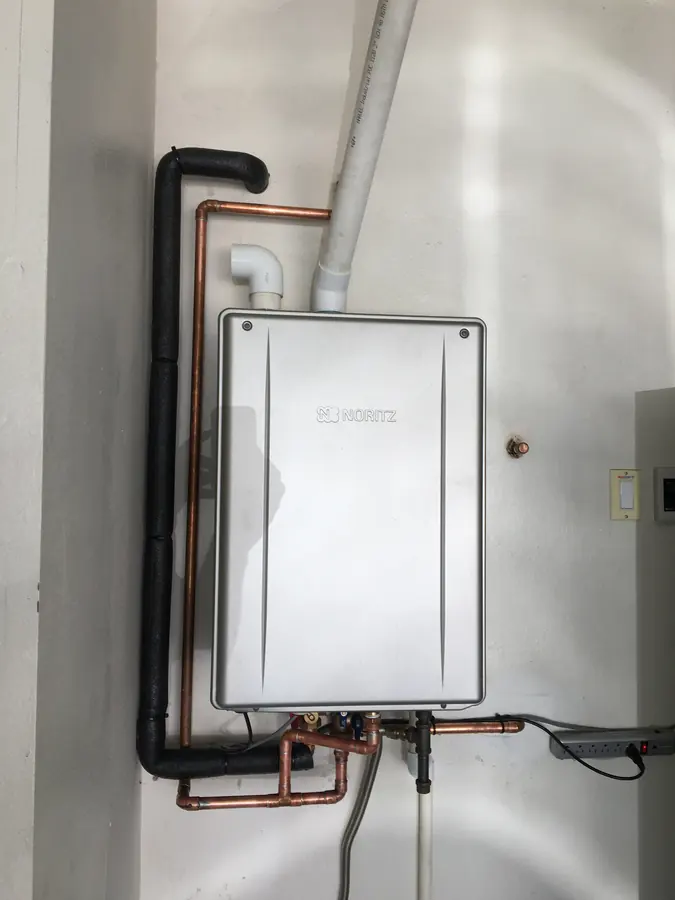
Tankless is worth a look when
- You regularly run out of hot water
- You want to free up floor space in the garage
- You plan to stay long enough to benefit from the longer life
- The plumber confirms the gas supply and venting can support it
Questions to ask before you choose
- Is my gas line large enough for a tankless unit, and if not, what does upsizing involve?
- Where would the new unit vent, and does that need HOA approval?
- Is a permit included in the quote?
- Does my home need an expansion tank?
- What warranty comes with the unit and with the labor?
Whichever you choose, California requires a tank water heater to be strapped against earthquakes, and the relief valve needs to discharge to a safe location.